

UNKNOWN transport operation is used when the shipment origin and destination are known, but the transport mode is not.
TerraTwin tries a sequence of specific fallback transport modes in order, modeling each one in turn until a route can be calculated successfully.
Basic shape
Set the transport operationtype to UNKNOWN:
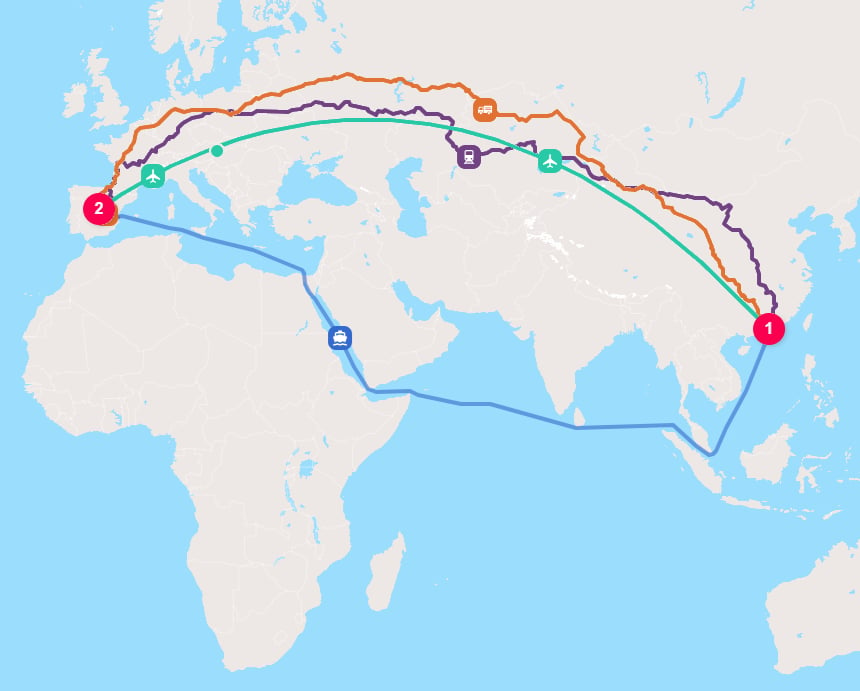
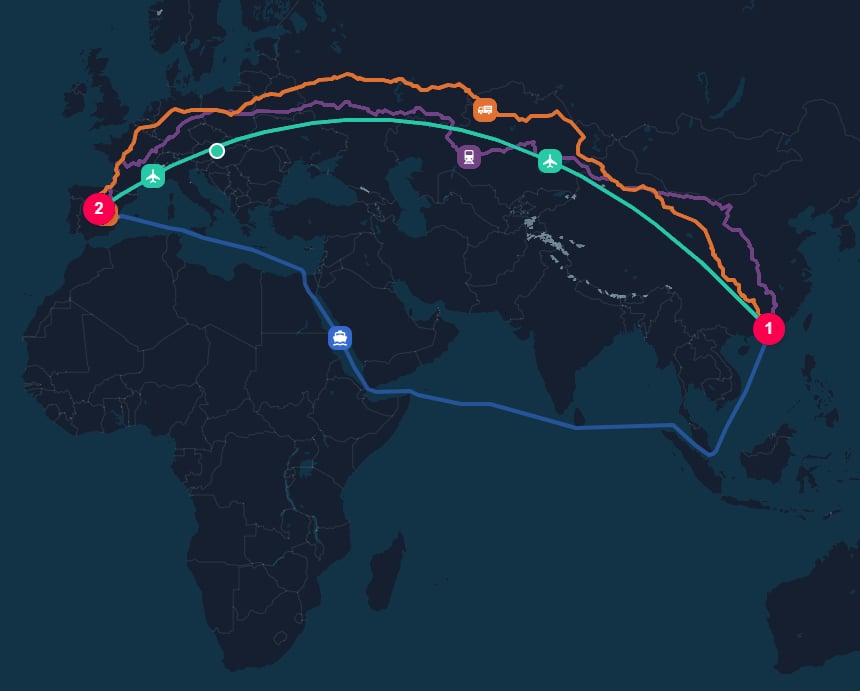
Possible fallback transport modes for an UNKNOWN shipment from Shenzhen to Madrid.
Properties
Mode-specific properties such as a vehicle, train type, vessel, or aircraft cannot be configured on an
UNKNOWN operation. To control those details, select the transport mode explicitly.
Omitting the transport chain
LeavingtransportChain out of the request, or providing an empty array, has effectively the same calculation behavior as a single UNKNOWN operation:
UNKNOWN element when you want to provide an operation level id or context and have it returned with the corresponding result.
Choosing the fallback order
By default, TerraTwin tries the following modes in order:ROADWATERAIR
options.fallbackTransportModes to provide a different order:
RAIL first, followed by ROAD, WATER, and AIR.
The order matters: the first mode that succeeds is selected, even if a later mode would also be feasible.
The supported fallback modes are AIR, RAIL, ROAD, and WATER.
Recommendations
1
Use UNKNOWN only when the mode is genuinely unknown
Select a specific transport type when the shipment mode is available. This gives you control over mode specific parameters and produces a more deliberate calculation.
2
Order fallback modes deliberately
Put the most plausible or preferred mode first. TerraTwin stops at the first mode that can be routed and calculated successfully.
3
Provide enough cargo and location detail
Fallback operations use default mode configurations, but accurate cargo weight, category, and locations still improve vehicle selection, routing, and emissions results.